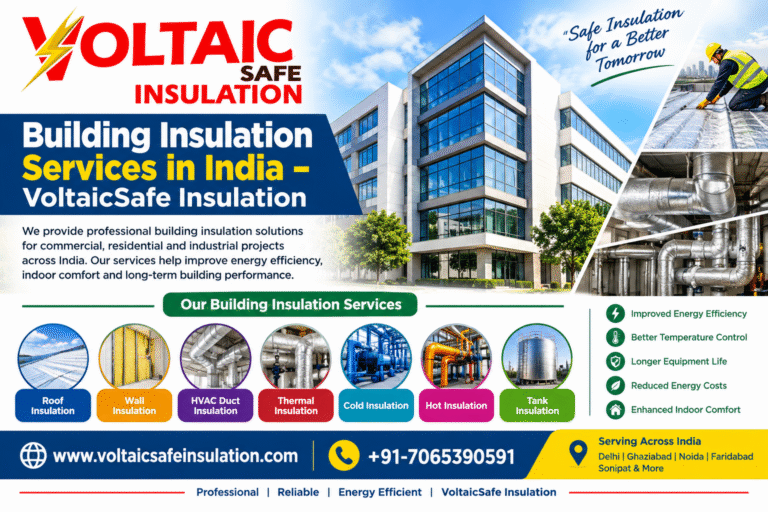
Building insulation is an important part of modern construction. A properly insulated building can maintain a more comfortable indoor environment, reduce unwanted heat transfer, and support better energy efficiency. With increasing temperatures, rising energy costs, and greater demand for efficient buildings, insulation has become an important consideration for residential, commercial, and industrial projects.
VoltaicSafe Insulation provides professional building insulation solutions designed to meet the requirements of different types of buildings and applications. From thermal insulation to HVAC duct insulation, the company offers solutions that can help improve building performance and provide long-term benefits.
What Is Building Insulation?
Building insulation is the use of specialized materials to reduce the transfer of heat between the interior and exterior of a building. Depending on the design and application, insulation may be installed on roofs, walls, ceilings, floors, ducts, pipelines, and other building components.
During summer, insulation can help reduce the amount of external heat entering a building. During cooler periods, it can help reduce heat loss from conditioned spaces. The overall objective is to improve temperature control and reduce the workload on heating and cooling systems.
The effectiveness of an insulation system depends on several factors, including material selection, thickness, installation quality, building design, climate, and the specific application.
Importance of Building Insulation
Buildings are exposed to changing outdoor temperatures throughout the year. Without appropriate insulation, heat can easily move through roofs, walls, ceilings, windows, and other surfaces. This can increase the demand for air conditioning or heating.
A properly planned insulation system can help reduce unnecessary heat transfer. It can also contribute to improved indoor comfort and more efficient operation of HVAC systems.
For commercial and industrial buildings, these benefits can be particularly important because HVAC and temperature-control systems may operate for long hours. Reducing heat gain or heat loss can support efficient building operations.
Thermal Insulation for Buildings
Thermal insulation is one of the key components of building insulation. It can be applied to different areas depending on the requirements of the project.
Roof insulation is useful for reducing heat entering a building from the roof surface. Wall and ceiling insulation can help control heat transfer through the building envelope. Insulation around HVAC ducts can help maintain the temperature of conditioned air as it travels through the building.
VoltaicSafe Insulation provides thermal insulation solutions for commercial, industrial, and other building applications.
HVAC Duct Insulation
HVAC systems are responsible for maintaining indoor temperature and air quality in many modern buildings. However, uninsulated or poorly insulated ducts can experience unwanted heat transfer.
HVAC duct insulation helps maintain the temperature of air moving through ductwork. It can also help reduce condensation on cold-air ducts when the system is correctly designed and installed.
Professional duct insulation requires appropriate material selection, surface preparation, joint treatment, and finishing. VoltaicSafe Insulation provides HVAC ducting and insulation services according to project requirements.
Cold Insulation in Buildings
Cold insulation is commonly used in air-conditioning and refrigeration applications. Chilled-water pipelines, refrigeration lines, and cold-air duct systems may require insulation to reduce heat gain and control condensation.
Moisture protection is an important consideration in cold insulation. If moisture enters the insulation system, its performance may decrease and the surrounding components may be affected.
For this reason, proper installation of insulation and vapour-barrier systems is essential for cold applications.
Hot Insulation Applications
Building and industrial facilities may also contain hot pipelines, boilers, hot-water systems, and other temperature-sensitive equipment. Hot insulation can help reduce heat loss and maintain operating temperatures.
It can also reduce the temperature of exposed surfaces, which may provide an additional safety benefit in areas where people work near hot equipment.
The appropriate insulation material and thickness should be selected according to the operating temperature and application requirements.
Benefits of Building Insulation
Professional building insulation can provide a range of benefits, including:
- Reduced unwanted heat transfer
- Improved indoor temperature control
- Support for energy-efficient HVAC operation
- Reduced heat gain through roofs and walls
- Improved comfort inside occupied spaces
- Condensation control in suitable applications
- Protection of certain building services and equipment
- Support for efficient long-term building operation
- Improved performance of HVAC systems
The actual performance depends on the building design, insulation material, thickness, installation method, and environmental conditions.
Building Insulation for Commercial and Industrial Projects
Commercial offices, shopping complexes, hospitals, hotels, warehouses, factories, educational institutions, and industrial facilities can all have different insulation requirements.
A factory may require insulation for process equipment and pipelines, while an office building may primarily require thermal and HVAC duct insulation. Warehouses and industrial buildings may require roof or wall insulation depending on their use and environmental conditions.
Therefore, building insulation should be planned according to the building’s purpose, local climate, temperature requirements, and HVAC design.
Why Choose VoltaicSafe Insulation?
VoltaicSafe Insulation provides professional insulation services for different commercial and industrial requirements. The company’s services include building insulation, thermal insulation, hot insulation, cold insulation, tank insulation, HVAC ducting, and duct insulation.
The focus is on providing practical insulation solutions based on site conditions and project requirements. Proper installation is an important part of achieving reliable insulation performance, and every application may require a different approach.
VoltaicSafe Insulation serves clients in Delhi, Ghaziabad, Noida, Faridabad, Sonipat, and across India.
Conclusion
Building insulation is an important investment for modern construction. By reducing unwanted heat transfer and supporting better temperature control, insulation can contribute to energy-efficient and comfortable buildings.
From thermal insulation and HVAC duct insulation to hot and cold insulation applications, the right solution depends on the building’s design and operational requirements. Professional installation can help ensure that insulation materials perform effectively over the intended service period.
VoltaicSafe Insulation provides building and industrial insulation solutions across India, helping businesses address their thermal and HVAC insulation requirements.
Contact VoltaicSafe Insulation
Website: www.voltaicsafeinsulation.com
Phone: +91-7065390591
VoltaicSafe Insulation – Safe Insulation for a Better Tomorrow.